For organizations that rely on the IBM™ System z platform, mainframe modernization is a priority for IT agility and streamlined information access to support evolving business needs. How you approach it is just as important and should include considerations for Total Cost of Ownership (TCO), which can be vital to business growth. DataDirect Shadow is resetting the bar for cost-effective mainframe integration through its single, unified architecture and patent-pending zIIP specialty engine exploitation technology. Up to 99% of the integration processing for Web services supporting Service-Oriented Architectures (SOA) or large data queries can be offloaded to no-charge areas of the mainframe. Not only does it reduce operational expenses, Shadow’s intuitive interface can increase developer productivity for improved project ROI.
![]()
![]()
A Unified Mainframe Integration Architecture
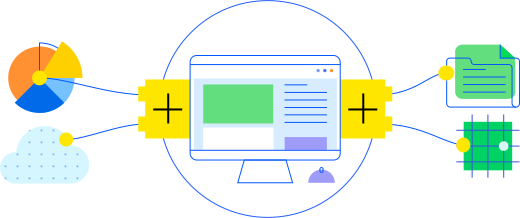
Growth, mergers, new technologies — all add to the increasing problem of integration complexity. Left unchecked, this gridlock of interconnectivity can drain infrastructure agility and lead to competitive disadvantage. DataDirect's Shadow addresses this problem with a high-performance foundation architecture to support all the industry standard requirements for integrating mainframe data, business logic, and screens in support of modernization efforts utilizing SOA and data-centric business intelligence initiatives.
The Industry Leading Mainframe Integration Suite
Industry research firms Gartner and Forrester have both reviewed Shadow technology as the leading technology for mainframe integration. The Shadow server is a robust, multi-threaded, native runtime that serves as the architectural framework underpinning DataDirect’s standards-based mainframe integration products:
Minimize development costs associated with mainframe integration
Java and .NET developers have a variety of options for quickly developing new applications. However, due to the proprietary nature of application and data sources on the mainframe, these developer skills and tools often cannot be used. This increases both development time and costs due to requirements to purchase proprietary development tools and train developers to use them. Shadow employs a different approach – it exposes these proprietary applications and data sources in a standards-based manner that enables development using ubiquitous tooling and skills.
Shadow Studio
Shadow enables simple administration to publish mainframe data, business logic, and process (screen-based) assets into reusable industry standard components. With its intuitive, Eclipse-based GUI, The Shadow Studio enables non-mainframe-experts to quickly and easily publish mainframe resources as Web services, real-time events, SQL tables or stored procedures, or web resources. To meet the increasing requirements of mainframe SOA, Shadow Studio includes BPEL 2.0 support, including a graphic BPEL designer and BPEL run-time management interface. To ensure integration integrity, The Shadow Studio provides a universal view into all mainframe resources for rapid diagnostics and ease of management.
Comprehensive Features To Ensure Integration Integrity
The best integration technology offers little real value if the integrity of the connection cannot be maintained. Shadow provides a comprehensive list of features to ensure the availability of business critical applications that rely on Shadow technology.
For organizations that want to enhance their Shadow implementations, there are Advanced Features that provide expanded functionality for security, scalability, transactional integrity and auditing.
Topping the list of these features is the Shadow Instrumentation Server (SIS), which maintains a fully integrated, comprehensive real-time, end-to-end systems management environment for all mainframe integration scenarios. Within SIS, activity is traced and integrated from all mainframe nodes within a Sysplex and exposed graphically via the Shadow Studio. Such information is ideally suited for development productivity, operational support and corporate compliance.
Exploitation of IBM zIIP and zAAP Specialty Engines
The Shadow architecture has been extended to exploit IBM's latest mainframe architectural facilities, specifically, the zIIP and zAAP specialty engines. Specialty engines are processors very similar to the mainframe General Purpose Processor (GPP), with two key differences — their workloads do not count against mainframe MIPs or MSUs and they are not speed restricted, but run at full capacity. With Shadow's advanced middleware design, processing intensive workloads associated with SOA or data queries are diverted from the GPP and offloaded to the zIIP. A cost effective strategy for expanded mainframe SOA initiatives is provided by Shadow's exploitation of the zAAP, allowing high performance industry standard BPEL 2.0 to drive Web services with the processing burden in this case being moved from the GPP to the zAAP engine. Shadow's exploitation of the zIIP specialty engine provides both improved performance and lower software costs. Shadow does not cause IBM or other third party code to become zIIP-enabled.
| Additional Features | |||||||
|