Oracle Database ODBC Driver

Select your platform
Table of Contents:
Overview
Progress DataDirect’s ODBC Driver for Oracle offers a high-performing, secure and reliable connectivity solution for ODBC applications to access Oracle data. Our ODBC driver can be easily used with SQL across all platforms - Unix / Linux, AIX, Solaris, Windows and HP-UX. Enjoy real-time analytics, reporting and business intelligence (BI) capabilities with your favorite tools such as Tableau, Power BI, Qlik, Excel, Cognos, Informatica, SAS, Board, MicroStrategy, SSIS, Oracle OBIEE and more.
- Handle high volume and velocity easily with high performing Oracle ODBC Driver
- Supports all Oracle versions 23c R1 (23.2) and higher, Oracle 21c R1 (21.1) and higher, and Oracle 19c R1 (19.1) and higher
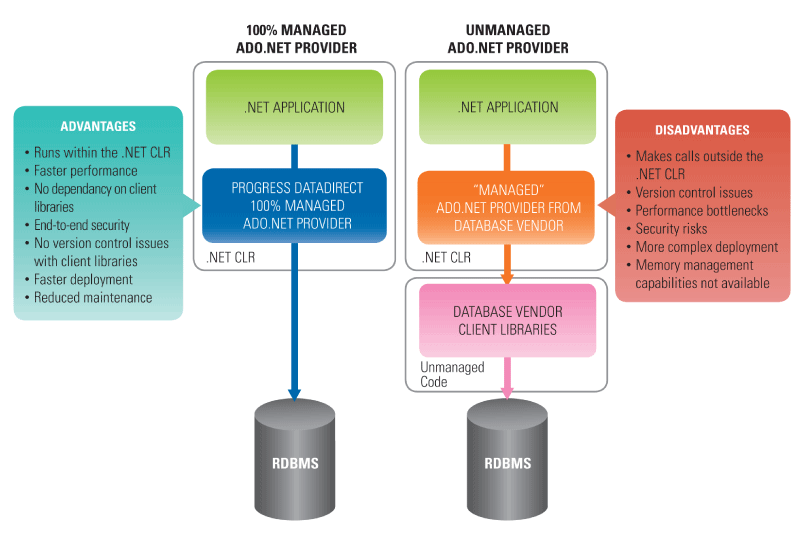
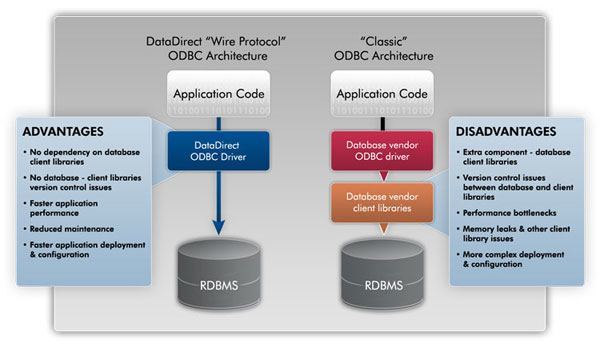
- Remove dependancy on vendor client libraries and vendor clients by using our ODBC driver for Oracle
Features
Support for Windows Truststore for SSL Certificate Validation
Fast
Superfast data loading and extraction that reduces the time and cost of running enterprise infrastructures
Support for Oracle Security Features
Our driver supports Oracle Advanced Security Data Integrity Checks, Oracle Wallet SSL Authentication and Oracle Internet Directory (OID) authentication without additional driver configuration.
Secure
Robust
Easy to Use
Versatile
Technical Specifications
All 32-bit versions of this driver are part of the Connect for ODBC Series. All 64-bit versions are part of the Connect64 for ODBC Series.
Progress DataDirect for ODBC for Oracle Wire Protocol Driver
Version 8.0.2
(32- and 64-bit drivers are available for all supported databases and platforms unless otherwise noted.)
ODBC Version Support
- Compatible with ODBC 3.8 applications
Database Support
- Oracle Database:
- Oracle 23c R1 (23.2) and higher
- Oracle 21c R1 (21.1) and higher
- Oracle 19c R1 (19.1) and higher
- Oracle Autonomous Data Warehouse Cloud
- Oracle Autonomous Transaction Processing Cloud
- Oracle Database Cloud Exadata Service
- Oracle Database Cloud Service
Authentication Support
- User ID and Password
- Client Authentication
- Kerberos Authentication
- NTLM Authentication
- Oracle Internet Directory (OID)
- Oracle Wallet Pasword Store
- Oracle Wallet SSL Authentication
- OS Authentication
Security Features Support
- Data Encryption
- Oracle Advanced Security
Operating System Support
AIX (32- and 64-bit)
- AIX, version 7.3 and higher
- AIX, version 5.3 and higher
HP
- HP-UX IPF, 11i version 3.0 (B.11.3x) and higher
- HP-UX PA-RISC (32-bit only),11i version 3.0 (B.11.3x) and higher
Note: For HP-UX PA-RISC, the 32-bit driver installers work only on 64-bit platforms. Please contact Technical Support if you want to use the driver on the 32-bit platforms.
Linux x86 (32- and 64-bit for AMD and Intel processors. 64-bit for Itanium II.)
- Debian Linux x86, version 12.0 and higher (AMD and Intel only)
- Oracle Linux x86, version 6.0, 7.0, 8.0, 9.0 and higher
- Red Hat Enterprise Linux x86, version 6.0, 7.0, 8.0, 9.0 and higher
- SUSE Linux Enterprise Server Linux x86, version 12, 15 and higher (AMD and Intel only)
- Ubuntu Linux x86, version 14.04, 16.04, 18.04, 20.04, 22.04 and higher (AMD and Intel only)
Linux on System Z (64-bit only)
- Oracle Linux x64, version 6.0, 7.0, 8.0, 9.0 and higher
- Red Hat Enterprise Linux x64, version 6.0, 7.0, 8.0, 9.0 and higher
- SUSE Linux Enterprise Server Linux x64, version 12, 15 and higher
Solaris (32- and 64-bit)
- Solaris x86, version 10 (Solaris 5.10), 11 and higher
- Solaris on SPARC, version 10, 11 and higher
Note: For Solaris and Solaris on SPARC, the 32-bit driver installers work only on 64-bit platforms. Please contact Technical Support if you want to use the driver on the 32-bit platforms.
Windows (32- and 64-bit)
- Windows (x86), version 10, 11 and higher
- Windows Server (x86), version 2012, 2016, 2019, 2022 and higher
Driver/Client Software Requirements
- No requirements
Documentation
Progress DataDirect for ODBC for Oracle Wire Protocol Driver
Version 8.0.2
- DataDirect Product Compatibility Guide
- Installation Guide
- Windows Getting Started
- UNIX/Linux Getting Started
- User's Guide
- Reference
- Windows Readme
- UNIX/Linux Readme
- Documentation Archive